Integrating social login into a Java application used to mean handling OAuth flows by hand — request tokens, access tokens, callback URLs, and every provider's quirks. Spring Social wraps all of that into a clean, consistent abstraction so you can focus on what your app actually does with the connection.
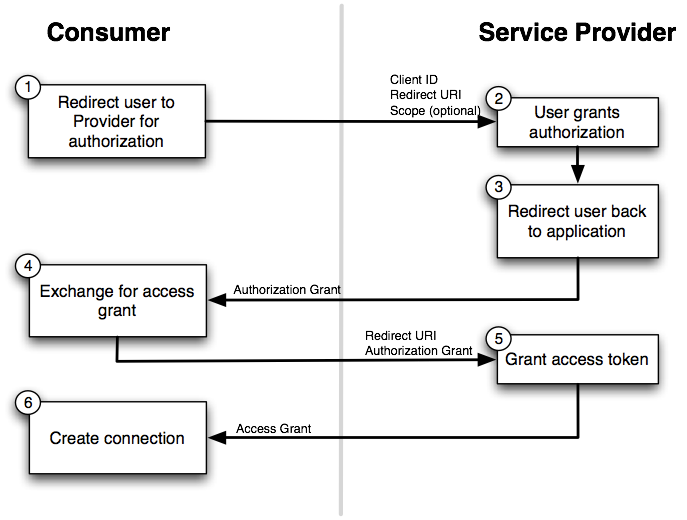
Spring Social OAuth sequence flow
Two Things Spring Social Does
Spring Social solves two distinct problems that are often confused:
- Social Provider Connection & API Access — connect a user's account to a provider (Facebook, LinkedIn, Twitter) and call that provider's API on their behalf.
- Provider-Based Authentication — let users sign in to your app using their social account instead of a local username/password.
1. Connecting to a Provider & Calling Its API
Before your app can talk to Facebook, you register it at the Facebook Developer portal and get an App ID and App Secret. Spring Social handles the OAuth dance from there — requesting authorization, exchanging the code for an access token, and storing it so future API calls don't need user interaction.
Once connected, Spring Social provides a typed API for each provider. For Facebook:
Facebook API Operations
CommentOperations— read and post comments on Facebook objectsEventOperations— create events, manage RSVPsFeedOperations— read and write to a user's wallFriendOperations— fetch friend lists and mutual connectionsGroupOperations— access group details and member listsLikeOperations— query and manage likesMediaOperations— albums, photos, videosPlacesOperations— check-in functionalityUserOperations— profile data and profile picture
LinkedIn and Twitter have equivalent typed APIs. The pattern is consistent regardless of provider.
2. Provider-Based Authentication
This is the "Sign in with Facebook / LinkedIn / Twitter" button. Spring Social gives you two approaches depending on whether you use Spring Security:
- ProviderSignInController — standalone, no Spring Security dependency needed
- SocialAuthenticationFilter — plugs directly into Spring Security's filter chain
Both approaches match the incoming provider account to a local user account in your database. If a match is found, the user is signed in. If not, you redirect them to a registration flow.
Key Dependencies to Wire Up
ConnectionFactoryLocator— resolves the right factory for each providerUsersConnectionRepository— persists the OAuth connection per userSignInAdapter— your hook to establish the local session once identity is confirmed
When to Use Spring Social
Spring Social shines when you need a clean Java abstraction over multiple OAuth providers without duplicating flow logic. If you only need one provider and you're already on Spring Security 5+, the built-in OAuth2 client support may be sufficient. But for multi-provider setups with API access needs, Spring Social's typed bindings save real time.